


Commercial -
Favona facility taps Auckland’s freight future
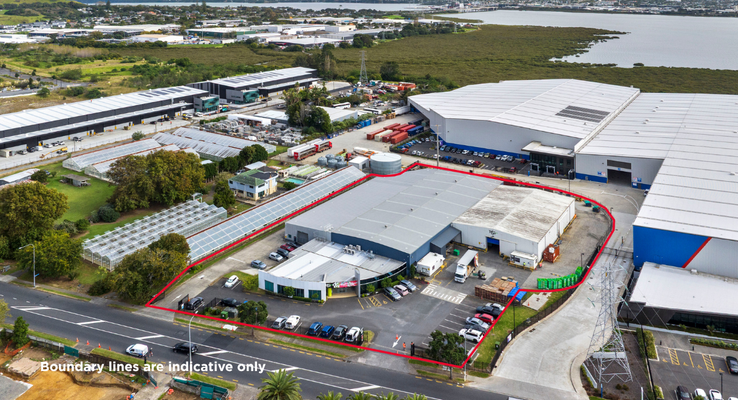
A substantial industrial facility positioned within one of Auckland’s most strategically evolving logistics corridors is being brought to market, offering investors, owner-occupiers and add-value buyers a rare opportunity to secure scale, functionality and future relevance in a tightly held precinct, Bayleys brokers say.
Bayleys South Auckland Commercial and Industrial director, Sunil Bhana, is marketing the 8,619sqm (more or less, subject to subdivision) freehold property at 42 Favona Road, together with colleagues James Valintine and Scott Campbell, for sale by deadline, closing at 2:00 pm on Thursday, 21st May 2026 (unless sold prior).
The offering comprises a 3,786sqm industrial facility, underpinned by a functional warehouse, established temperature-controlled infrastructure, generous yard areas, and full drive-around capability. The property will be sold with vacant possession, enabling immediate occupation or repositioning.
Bhana says opportunities of the property’s scale and flexibility in Favona are increasingly scarce, particularly as infrastructure investment across the wider airport corridor begins to reshape occupier demand.
“Favona sits at the intersection of Auckland’s most important freight and transport networks, with direct access to State Highway 20 and efficient connectivity through to State Highway 1,” he says.
“What we’re seeing now is infrastructure translating into real occupier behaviour. Businesses are prioritising locations that reduce travel times, improve supply chain productivity, and provide certainty around access – and this precinct delivers on all three.”
The subject property’s proximity to Auckland Airport places it within the immediate sphere of one of New Zealand’s largest infrastructure programmes, with a multi-billion-dollar redevelopment underway that will expand terminal capacity, upgrade transport integration, and further embed the airport as a long-term logistics and employment hub.
At the same time, upgrades to the State Highway 20 and State Highway 20B corridor have materially improved freight movement across South Auckland, reducing congestion and strengthening links between the airport, inland ports and key industrial nodes, including Wiri and East Tāmaki.
Bayleys South Auckland Commercial and Industrial director, James Valintine, says these structural shifts are reinforcing the appeal of well-located industrial assets, particularly those that can accommodate specialised uses.
“The inclusion of temperature-controlled infrastructure immediately broadens the occupier profile, appealing to food production, storage and distribution businesses that require temperature-controlled environments but are facing limited supply across the market,” he says.
“Equally, the underlying site and building configuration provide scope for repositioning, making it attractive to investors seeking to add value through refurbishment, re-leasing or operational optimisation.”
The improvements comprise approximately 2,446sqm of warehousing, 886sqm of temperature-controlled storage and 452sqm of office accommodation, supported by 47 on-site car parks and a substantial yard area of circa 1,000sqm. Dual clear-span warehouse bays and multiple roller door access points support efficient workflow and vehicle circulation.
Bayleys Industrial national director Scott Campbell says the vacant possession profile is a key differentiator, particularly as businesses look to secure premises aligned with future growth.
“Owner-occupiers are re-emerging as a driving force in the industrial sector, particularly those seeing control over their operations in supply-constrained locations,” he says.
“With infrastructure investment accelerating across the airport corridor, assets like this are increasingly viewed as long-term strategic positions within Auckland’s logistics network.”
He adds that the combination of scale, location and flexibility positions the property to benefit both immediate occupation and evolving leasing trends.
“As transport efficiency improves and the airport precinct continues to intensify, we expect sustained demand for functional industrial space in surrounding locations. This is a precinct where accessibility, proximity, and adaptability converge – exactly what occupiers are looking for.”
Contact us


